
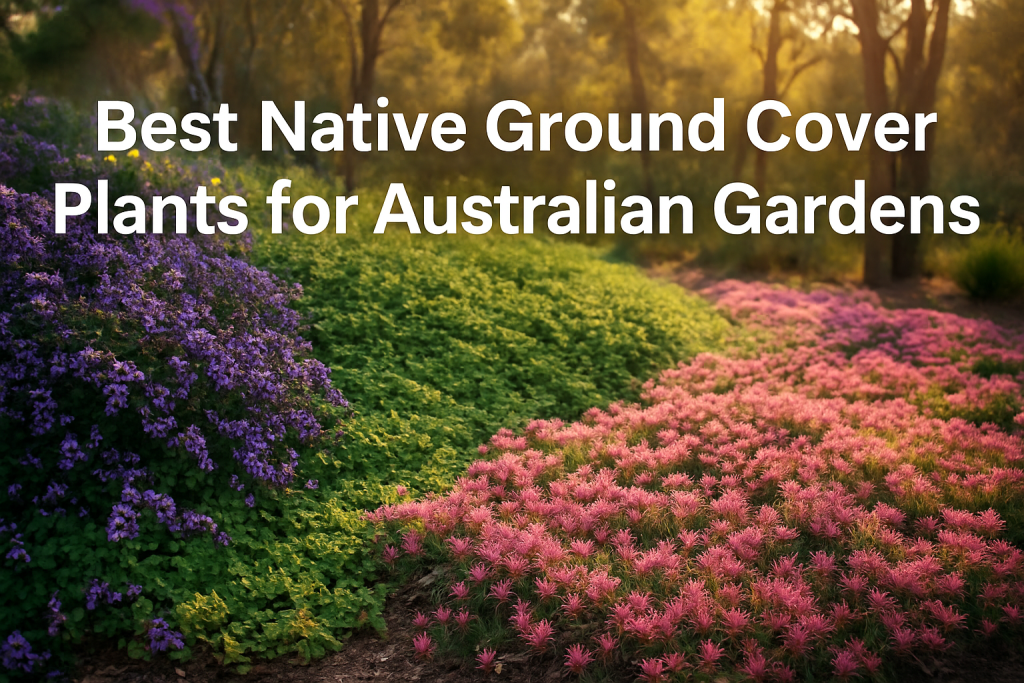
Picture this: you’re standing in your backyard on a scorching January afternoon, watching water cascade over your thirsty lawn while your water bill climbs higher than the temperature. Meanwhile, your neighbour’s garden looks lush and green with barely any effort, thanks to their smart choice of native ground covers. I’ve been there, and I can tell you that discovering the best native ground cover plants for Australian gardens completely transformed not just my landscape, but my entire approach to gardening.
Ground covers are the unsung heroes of Australian gardens. They work tirelessly beneath our feet, suppressing weeds, preventing erosion, conserving precious water, and creating stunning visual carpets that connect our garden spaces. Unlike traditional lawns that demand constant mowing, fertilising, and watering, native ground covers have evolved over millennia to thrive in our unique climate. They’re the smart gardener’s secret weapon, and I’m excited to share everything I’ve learned about choosing and growing the best native ground cover plants for Australian gardens.
Key Takeaways
🌿 Native ground covers save water and maintenance time – Most Australian native ground covers require 50-70% less water than traditional lawns once established, with minimal mowing or fertilising needed.
🦋 They support local wildlife – Native ground covers provide essential habitat and food sources for native bees, butterflies, and small birds while creating biodiversity corridors in urban environments.
🏡 Versatility for every garden situation – From full sun to deep shade, coastal salt spray to inland frost, there’s a native ground cover perfectly suited to your specific conditions.
💰 Cost-effective long-term solution – While initial planting costs may be higher than lawn seed, native ground covers save thousands of dollars over their lifetime through reduced water, fertiliser, and maintenance requirements.
🎨 Year-round visual interest – Many native ground covers offer spectacular seasonal flowers, interesting foliage textures, and evergreen coverage that keeps gardens looking beautiful throughout the year.
Why Ground Covers Are Essential for Australian Gardens
Let me share a story that changed my perspective on gardening forever. Five years ago, I inherited a sloped section of my property that was constantly eroding during Sydney’s summer storms. I’d tried everything—mulch, retaining walls, even expensive erosion control fabric. Nothing worked until a landscaper friend suggested native ground covers. Within eighteen months, that problematic slope became the most beautiful, low-maintenance part of my entire garden.
Ground covers serve multiple critical functions that make them indispensable in Australian landscapes:
Weed Suppression That Actually Works
Traditional gardens require constant weeding, but dense ground covers create a living mulch that physically blocks weed seeds from germinating. Once established, plants like Myoporum parvifolium (Creeping Boobialla) spread so thickly that weeds simply can’t compete. I’ve gone from spending hours each weekend pulling weeds to maybe ten minutes per month spot-checking.
Erosion Control for Challenging Terrain
Australia’s intense rainfall events can devastate exposed soil. Ground covers stabilise soil with their root systems while their foliage breaks the impact of raindrops. On slopes, embankments, and areas prone to runoff, they’re absolutely essential. The difference in my sloped garden was dramatic—what was once a muddy mess after every storm became a stable, thriving ecosystem.
Water Conservation in a Dry Continent 💧
This is where native ground covers truly shine. Once established, most require only occasional deep watering during extended dry periods. Compare this to traditional lawns that need watering 2-3 times weekly in summer. In Melbourne, a friend calculated she saved over 150,000 litres of water annually by replacing her front lawn with native ground covers—that’s a significant reduction in both environmental impact and water bills.
Aesthetic Value and Garden Unity
Ground covers create visual flow, connecting different garden elements into a cohesive design. They soften hard edges, fill gaps between stepping stones, and provide textural contrast to taller plants. The variety of foliage colours, textures, and seasonal flowers available in native species means you’re never sacrificing beauty for practicality.
For those interested in caring for native Australian gardens, ground covers form the foundation of a sustainable, low-maintenance landscape that works with our climate rather than against it.
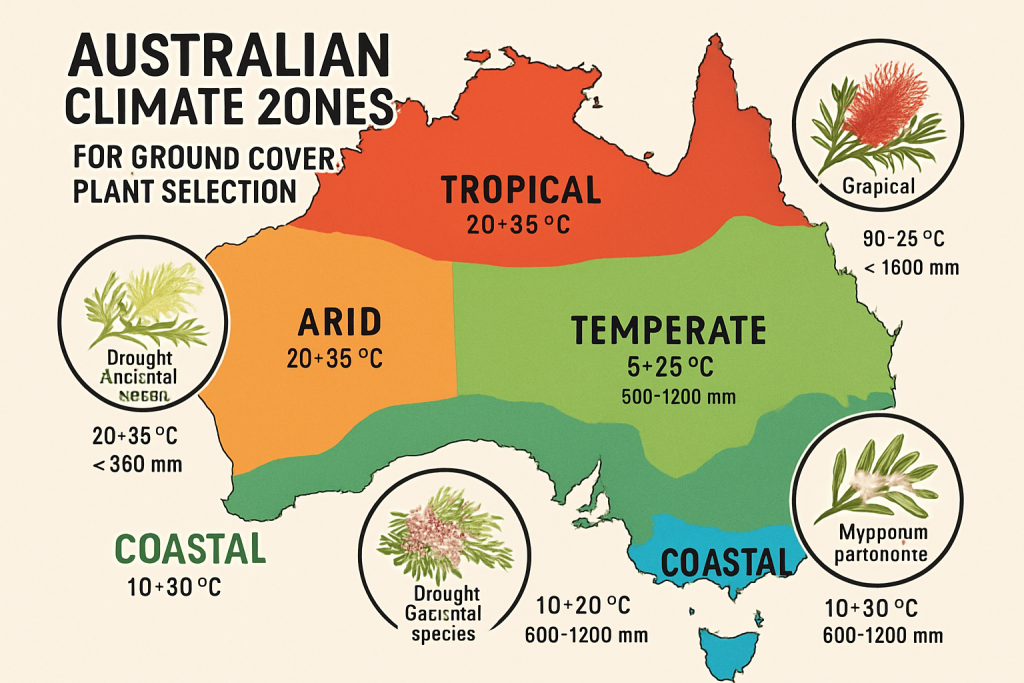
Climate Considerations: Matching the Best Native Ground Cover Plants for Australian Gardens to Your Region
Australia’s vast size means we experience everything from tropical monsoons to alpine frosts, and choosing ground covers suited to your specific climate is absolutely critical for success. I learned this the hard way when I first moved from temperate Sydney to subtropical Brisbane—half my carefully chosen plants struggled until I understood the importance of climate matching.
Tropical and Subtropical Zones (Northern Australia, Coastal Queensland, Northern NSW)
Climate characteristics: High humidity, warm winters, intense summer rainfall, minimal to no frost
Best performers:
- Scaevola aemula (Fan Flower) – Thrives in humidity and tolerates salt spray
- Hibbertia scandens (Climbing Guinea Flower) – Loves warmth and moisture
- Pratia purpurascens (Whiteroot) – Excellent for shaded tropical gardens
In these regions, the challenge isn’t drought but rather managing vigorous growth and occasional fungal issues during the wet season. Choose species with good air circulation and avoid overcrowding.
Temperate Zones (Sydney, Melbourne, Adelaide, Perth)
Climate characteristics: Moderate rainfall, distinct seasons, occasional frost, hot dry summers
Best performers:
- Myoporum parvifolium – The workhorse of temperate gardens
- Grevillea lanigera and other Grevillea ground covers – Spectacular flowering
- Hardenbergia violacea (Purple Coral Pea) – Beautiful winter/spring flowers
- Chrysocephalum apiculatum (Yellow Buttons) – Excellent drought tolerance
This is where the widest variety of native ground covers excel. The moderate climate suits most species, though you’ll want to provide some summer water during establishment and extreme heatwaves.
Arid and Semi-Arid Zones (Inland NSW, SA, WA, Central Australia)
Climate characteristics: Low rainfall, extreme temperature fluctuations, intense sun, occasional frost
Best performers:
- Eremophila glabra prostrate forms – Exceptional drought tolerance
- Ptilotus obovatus (Cotton Bush) – Thrives in dry conditions
- Einadia nutans (Climbing Saltbush) – Tolerates poor soils and drought
In these challenging conditions, establishment is everything. Plant in autumn, water deeply but infrequently to encourage deep rooting, and be patient—these plants may look sparse initially but will fill in beautifully once established.
Cool Temperate and Alpine Zones (Tasmania, Victorian High Country, Southern Tablelands)
Climate characteristics: Cold winters with frost and occasional snow, cool summers, reliable rainfall
Best performers:
- Viola hederacea (Native Violet) – Frost hardy and shade tolerant
- Dichondra repens (Kidney Weed) – Excellent lawn alternative in cool climates
- Acaena novae-zelandiae (Bidgee-widgee) – Handles frost and foot traffic
Cold-climate gardeners often feel limited in their choices, but these tough natives prove that beautiful ground covers can handle whatever winter throws at them.
Coastal Zones (All States)
Special considerations: Salt spray, sandy soils, strong winds, reflected heat
Best performers:
- Carpobrotus glaucescens (Pigface) – The ultimate coastal survivor
- Rhagodia spinescens (Creeping Saltbush) – Excellent salt tolerance
- Myoporum parvifolium – Handles salt spray well
I’ve watched coastal gardens where these plants not only survive but absolutely thrive in conditions that would kill most exotic species. The salt tolerance of Australian natives is remarkable.
Top 15 Native Ground Cover Plants: Detailed Profiles
Now let’s dive into the stars of the show—the best native ground cover plants for Australian gardens. I’ve grown most of these personally, and each has earned its place on this list through proven performance, availability, and versatility.
1. Myoporum parvifolium (Creeping Boobialla) ⭐
Appearance: Dense, spreading shrub with small, succulent-like leaves and masses of white, star-shaped flowers with purple spots.
Growth rate and spread: Fast-growing, spreading 1-3 metres wide. Can cover large areas quickly—mine spread 2 metres in just two years.
Height and coverage area: 10-30cm tall depending on variety. ‘Pink’ variety stays lower at 10-15cm.
Soil and sun requirements: Adaptable to most soils including clay and sand. Full sun to part shade. Excellent drainage essential.
Flower colour and season: White with purple spots, spring and summer. Attracts native bees beautifully.
Drought tolerance: Excellent once established. Requires minimal supplementary watering.
Foot traffic tolerance: Moderate—handles occasional walking but not heavy foot traffic.
Best uses: Slopes, erosion control, large-scale coverage, coastal gardens, under eucalypts. This is my go-to recommendation for beginners because it’s nearly impossible to kill and looks great year-round.
2. Grevillea lanigera (Woolly Grevillea)
Appearance: Soft, grey-green foliage with a woolly texture. Stunning pink to red spider-like flowers.
Growth rate and spread: Moderate to fast, spreading 1-2 metres.
Height and coverage area: 30-60cm tall, creating a mounded effect.
Soil and sun requirements: Well-drained soil essential—hates wet feet. Full sun. Tolerates poor, sandy soils.
Flower colour and season: Pink to red, winter through spring. Absolute magnet for honeyeaters and native bees.
Drought tolerance: Excellent. Thrives with minimal water once established.
Foot traffic tolerance: Low—best admired rather than walked on.
Best uses: Feature plantings, bird-attracting gardens, rockeries, well-drained slopes. I planted this specifically to attract birds, and it worked spectacularly—I now have regular visits from Eastern Spinebills.
3. Hardenbergia violacea (Purple Coral Pea)
Appearance: Vigorous climber/ground cover with dark green leaves and cascades of purple pea-shaped flowers.
Growth rate and spread: Fast-growing, can spread 2-4 metres if left unchecked.
Height and coverage area: 30-50cm as ground cover, but will climb if given support.
Soil and sun requirements: Adaptable to most soils. Full sun to part shade—flowers best in sun.
Flower colour and season: Purple (also white and pink varieties available), late winter to spring. The flowering display is absolutely breathtaking.
Drought tolerance: Good once established. Benefits from occasional deep watering in extended dry periods.
Foot traffic tolerance: Low to none.
Best uses: Cascading over walls, covering slopes, under trees, feature displays. This plant stops people in their tracks when it’s flowering—I’ve had neighbours knock on my door asking what it is.
4. Scaevola aemula (Fan Flower)
Appearance: Bright green foliage with distinctive fan-shaped blue-purple flowers.
Growth rate and spread: Moderate, spreading 50cm-1 metre.
Height and coverage area: 20-50cm tall, forming dense mounds.
Soil and sun requirements: Adaptable, prefers well-drained soil. Full sun to part shade.
Flower colour and season: Blue-purple (white varieties available), flowers almost year-round in mild climates.
Drought tolerance: Moderate—appreciates regular water but tolerates dry spells.
Foot traffic tolerance: Low.
Best uses: Coastal gardens, hanging baskets, borders, rockeries. Excellent in pots too. The nearly continuous flowering makes this a favourite for adding consistent colour.
5. Chrysocephalum apiculatum (Yellow Buttons)
Appearance: Silver-grey foliage topped with bright golden-yellow button flowers.
Growth rate and spread: Moderate, spreading 30-60cm.
Height and coverage area: 15-30cm tall.
Soil and sun requirements: Well-drained soil essential. Full sun. Excellent for poor soils.
Flower colour and season: Golden yellow, spring through autumn. The flowers dry beautifully and persist.
Drought tolerance: Excellent—one of the best for dry gardens.
Foot traffic tolerance: Low.
Best uses: Rockeries, dry gardens, borders, between pavers. The silver foliage provides year-round interest even when not flowering.
6. Carpobrotus glaucescens (Pigface)
Appearance: Thick, succulent triangular leaves with large, vibrant pink-purple daisy flowers.
Growth rate and spread: Fast and vigorous, spreading several metres if unchecked.
Height and coverage area: 10-20cm tall, spreads indefinitely.
Soil and sun requirements: Any soil including pure sand. Full sun. Thrives in coastal conditions.
Flower colour and season: Pink-purple, spring and summer.
Drought tolerance: Exceptional—can survive on rainfall alone in most areas.
Foot traffic tolerance: Moderate—the succulent leaves can be damaged but recover quickly.
Best uses: Coastal gardens, dune stabilisation, extreme slopes, fire-prone areas. This plant is virtually indestructible—I’ve seen it thriving in pure beach sand with no supplementary water.
7. Viola hederacea (Native Violet)
Appearance: Delicate kidney-shaped leaves with small purple and white flowers.
Growth rate and spread: Moderate, spreading 30-50cm.
Height and coverage area: 5-10cm tall, forms a delicate carpet.
Soil and sun requirements: Moist, well-drained soil. Part shade to full shade—perfect for under trees.
Flower colour and season: Purple and white, spring through autumn.
Drought tolerance: Low—needs consistent moisture.
Foot traffic tolerance: Moderate—one of the better choices for light foot traffic.
Best uses: Shaded areas, under trees, between pavers, lawn alternative in shade. This is my favourite for creating that woodland garden feel in shady spots.
8. Dichondra repens (Kidney Weed)
Appearance: Small, kidney-shaped bright green leaves forming a dense mat.
Growth rate and spread: Moderate to fast, spreading indefinitely.
Height and coverage area: 3-5cm tall, creating a lawn-like appearance.
Soil and sun requirements: Moist, well-drained soil. Part shade to full sun with adequate water.
Flower colour and season: Tiny greenish flowers, not showy.
Drought tolerance: Low to moderate—needs regular water in hot weather.
Foot traffic tolerance: Excellent—one of the best lawn alternatives.
Best uses: Lawn replacement, between pavers, high-traffic areas. This is what I recommend when people want a lawn-like appearance without the maintenance of traditional grass.
9. Pratia purpurascens (Whiteroot)
Appearance: Tiny rounded leaves with small white to pale blue flowers.
Growth rate and spread: Moderate, spreading 30-50cm.
Height and coverage area: 2-5cm tall, ultra-low growing.
Soil and sun requirements: Moist soil. Part shade to full shade.
Flower colour and season: White to pale blue, spring and summer.
Drought tolerance: Low—requires consistent moisture.
Foot traffic tolerance: Good—handles light to moderate traffic.
Best uses: Lawn alternative in shade, between pavers, pond edges. The tiny leaves create an almost moss-like appearance that’s quite charming.
10. Hibbertia scandens (Climbing Guinea Flower)
Appearance: Glossy dark green leaves with large, bright yellow flowers.
Growth rate and spread: Fast and vigorous, spreading 2-4 metres.
Height and coverage area: 30-50cm as ground cover, climbs if supported.
Soil and sun requirements: Adaptable to most soils. Full sun to part shade.
Flower colour and season: Bright yellow, mainly spring and summer but sporadic flowering year-round.
Drought tolerance: Moderate—appreciates regular water.
Foot traffic tolerance: None.
Best uses: Covering large areas quickly, slopes, under trees, cascading over walls. The bright yellow flowers are absolutely stunning against the dark foliage.
11. Kennedia prostrata (Running Postman)
Appearance: Trailing stems with distinctive red pea-shaped flowers.
Growth rate and spread: Moderate to fast, spreading 1-2 metres.
Height and coverage area: 10-20cm tall.
Soil and sun requirements: Well-drained soil. Full sun to part shade.
Flower colour and season: Scarlet red, winter through spring.
Drought tolerance: Good once established.
Foot traffic tolerance: Low.
Best uses: Colour contrast plantings, bird-attracting gardens, slopes. The vivid red flowers create incredible visual impact.
12. Brachyscome multifida (Cut-leaf Daisy)
Appearance: Finely divided, ferny foliage with masses of small daisy flowers.
Growth rate and spread: Moderate, spreading 30-50cm.
Height and coverage area: 15-30cm tall.
Soil and sun requirements: Well-drained soil. Full sun to part shade.
Flower colour and season: Mauve-pink (white varieties available), mainly spring but often flowers sporadically year-round.
Drought tolerance: Good—tolerates dry periods once established.
Foot traffic tolerance: Low.
Best uses: Rockeries, borders, cottage gardens, between shrubs. The delicate appearance belies its toughness.
13. Goodenia ovata (Hop Goodenia)
Appearance: Bright green toothed leaves with cheerful yellow flowers.
Growth rate and spread: Fast, spreading 1-2 metres.
Height and coverage area: 30-100cm tall depending on conditions and pruning.
Soil and sun requirements: Adaptable to most soils. Full sun to part shade.
Flower colour and season: Bright yellow, spring and summer.
Drought tolerance: Good once established.
Foot traffic tolerance: None.
Best uses: Quick coverage of large areas, informal gardens, under eucalypts. This is excellent for filling in gaps quickly while slower plants establish.
14. Einadia nutans (Climbing Saltbush)
Appearance: Silver-grey foliage with a soft, trailing habit.
Growth rate and spread: Moderate, spreading 1-2 metres.
Height and coverage area: 10-30cm tall.
Soil and sun requirements: Any soil including poor, saline soils. Full sun.
Flower colour and season: Inconspicuous flowers—grown for foliage.
Drought tolerance: Exceptional—thrives in arid conditions.
Foot traffic tolerance: Low to moderate.
Best uses: Dry gardens, poor soils, coastal areas, fire-prone areas. The silver foliage provides beautiful contrast in garden designs.
15. Dampiera linearis (Common Dampiera)
Appearance: Narrow leaves with bright blue flowers.
Growth rate and spread: Moderate, spreading 50cm-1 metre.
Height and coverage area: 20-40cm tall.
Soil and sun requirements: Well-drained soil. Full sun to part shade.
Flower colour and season: Bright blue, spring and summer.
Drought tolerance: Good once established.
Foot traffic tolerance: Low.
Best uses: Rockeries, borders, adding blue colour to plantings. True blue flowers are rare in native plants, making this particularly valuable for colour schemes.
Design Ideas: Creating Stunning Landscapes with Native Ground Covers
Now that you know the players, let’s talk about how to use them effectively. Garden design with ground covers is where art meets horticulture, and I’ve learned that thoughtful planning creates far better results than random planting.
Mass Planting for Impact 🎨
One of the most effective techniques is mass planting a single species for bold visual impact. I created a stunning display by planting 30 Hardenbergia violacea plants across a slope—when they flower in late winter, it’s a purple waterfall that stops traffic. Mass planting works best when:
- You have a large area to cover (minimum 5-10 square metres)
- You want a cohesive, unified look
- You’re working with a challenging site where consistency matters
- You want to make a bold statement with seasonal colour
Pattern Planting and Colour Combinations
For more visual interest, try creating patterns with contrasting colours and textures. Some combinations I’ve found particularly effective:
Silver and Purple Scheme:
- Chrysocephalum apiculatum (silver foliage, yellow flowers)
- Scaevola aemula (green foliage, purple flowers)
- Hardenbergia violacea (green foliage, purple flowers)
Coastal Cottage Garden:
- Carpobrotus glaucescens (succulent foliage, pink flowers)
- Brachyscome multifida (ferny foliage, mauve flowers)
- Myoporum parvifolium (dense green, white flowers)
Woodland Shade Garden:
- Viola hederacea (delicate purple and white)
- Pratia purpurascens (tiny white flowers)
- Dichondra repens (bright green carpet)
Layered Planting for Depth
Create visual depth by combining ground covers of different heights:
Back layer (40-60cm): Grevillea lanigera, Goodenia ovata
Middle layer (20-40cm): Scaevola aemula, Chrysocephalum apiculatum
Front layer (5-20cm): Myoporum parvifolium, Viola hederacea
This layering technique creates a more natural, less flat appearance that’s particularly effective on slopes or in border plantings.
Using Ground Covers Between Pavers and Stepping Stones
Low-growing, traffic-tolerant species transform hard landscapes into living pathways. My favourite combinations:
- Dichondra repens between large stepping stones—creates a lawn-like appearance
- Pratia purpurascens in paver gaps—adds tiny flowers and softens edges
- Viola hederacea in shaded courtyard pavers—brings life to dark corners
Plant these by removing some soil from joints, adding quality potting mix, and tucking in small plants or divisions. Water regularly until established.
Slope and Erosion Control Design
For slopes, plant in a staggered pattern rather than rows to create better coverage and visual interest. I use this formula:
- Top of slope: Slower-spreading, drought-tolerant species (Chrysocephalum, Grevillea)
- Mid-slope: Fast-spreading stabilisers (Myoporum, Hardenbergia)
- Bottom of slope: Moisture-tolerant species (Viola, Goodenia)
This approach works with the natural water flow down the slope rather than against it.
Under-Tree Planting
The area under established trees is notoriously difficult, but shade-tolerant native ground covers excel here. For success under trees:
- Choose shade-tolerant species: Viola hederacea, Pratia purpurascens, Hardenbergia violacea
- Plant in autumn when tree roots are less competitive
- Improve soil with compost but don’t mound against tree trunks
- Water regularly during establishment
- Accept that coverage may be thinner directly under the trunk
My under-tree plantings took two years to fully establish, but now they require virtually no maintenance and look beautiful year-round. For more tips on native Australian gardens, consider the specific needs of your existing trees.
Planting and Establishment Guide: Setting Your Ground Covers Up for Success
The difference between ground covers that thrive and those that merely survive often comes down to proper establishment. I’ve made plenty of mistakes over the years, and I want to help you avoid them.
Site Preparation: The Foundation of Success
Step 1: Eliminate existing weeds thoroughly
This is absolutely critical. I learned this the hard way when I planted over existing weeds, thinking the ground covers would outcompete them. Wrong. The weeds came back with a vengeance, and I spent months hand-weeding through my new plants.
Options for weed elimination:
- Organic method: Cover area with cardboard or thick newspaper, top with mulch, wait 8-12 weeks
- Manual removal: Dig out weeds completely, including roots
- Herbicide (if necessary): Use glyphosate-based products, wait recommended period before planting
Step 2: Improve soil structure
While native ground covers tolerate poor soils, they establish faster in improved conditions. For each square metre:
- Add 2-3cm of compost or aged manure
- For clay soils: Add gypsum (200g per square metre) and coarse sand
- For sandy soils: Add compost and aged manure to improve water retention
- Incorporate a native-specific slow-release fertiliser (follow package directions)
Step 3: Grade and level
Ensure water drains away from buildings and doesn’t pool in low spots. Ground covers don’t like waterlogging.
Spacing: Getting the Balance Right
Proper spacing determines how quickly you’ll get coverage and your initial plant costs. I use these general guidelines:
Fast-growing spreaders (Myoporum, Carpobrotus, Goodenia):
- 50-75cm apart for coverage in 12-18 months
- 75cm-1m apart for coverage in 18-24 months (more economical)
Moderate growers (Grevillea, Scaevola, Hardenbergia):
- 40-60cm apart for coverage in 12-18 months
- 60-80cm apart for coverage in 18-24 months
Slow growers (Chrysocephalum, Brachyscome):
- 30-40cm apart for coverage in 18-24 months
Small, low growers (Viola, Pratia, Dichondra):
- 20-30cm apart for coverage in 12-18 months
Calculate plants needed: (Area in square metres ÷ spacing in metres squared). For example, 10 square metres with 50cm spacing = 10 ÷ (0.5 × 0.5) = 40 plants.
Planting Technique
Best time to plant: Autumn is ideal in most regions—cooler temperatures and winter rain help establishment. Spring is second-best. Avoid planting in the heat of summer.
Planting process:
- Water plants thoroughly in their pots before planting
- Dig holes slightly larger than the pot
- Gently remove plant from pot, teasing out circling roots
- Plant at the same depth as in the pot—not deeper
- Backfill with soil, firming gently
- Water thoroughly to settle soil
- Apply 5-7cm of mulch around plants, keeping it away from stems
Initial Care: The Critical First Six Months
The establishment period determines long-term success. Here’s my proven routine:
Watering schedule:
- Weeks 1-2: Water every 2-3 days (daily in hot weather)
- Weeks 3-8: Water twice weekly
- Months 3-6: Water weekly (more in hot, dry weather)
- After 6 months: Reduce to fortnightly or monthly depending on species and climate
Pro tip: Deep, infrequent watering encourages deep root growth. Shallow, frequent watering creates shallow roots and weak plants.
Weed control:
Hand-pull any weeds that emerge. This is crucial in the first six months before the ground covers fill in.
Fertilising:
Apply a light application of native-specific fertiliser at 3 months and 6 months. Avoid high-phosphorus fertilisers—many natives are sensitive to phosphorus.
Long-Term Maintenance: Keeping Ground Covers Beautiful
Once established, native ground covers are remarkably low-maintenance, but they’re not no-maintenance. Here’s my annual routine:
Spring tasks:
- Light trim to shape and encourage dense growth
- Remove any dead material
- Apply slow-release native fertiliser
- Mulch refresh if needed
Summer tasks:
- Deep water during extended hot, dry periods
- Monitor for pests (rare, but occasionally caterpillars or scale)
Autumn tasks:
- This is prime planting time for filling gaps or expanding areas
- Remove fallen leaves if they’re smothering plants
Winter tasks:
- Minimal maintenance required
- Enjoy the flowers on winter-flowering species like Hardenbergia and Grevillea
Trimming and pruning:
Most ground covers benefit from an annual trim to maintain density and prevent them becoming leggy. I use hedge shears or a line trimmer on the highest setting for large areas. Trim after the main flowering period.
Problem-Solving: Common Challenges and Solutions
Even with the best native ground cover plants for Australian gardens, you’ll occasionally face challenges. Here’s how to address the most common issues I’ve encountered.
Dealing with Invasive Spread
Problem: Some ground covers (I’m looking at you, Carpobrotus and Hardenbergia) can spread beyond their intended areas.
Solutions:
- Install physical barriers (buried edging 20-30cm deep) at planting time
- Regular trimming to contain spread—I trim edges every 3-4 months
- Choose less vigorous varieties for small spaces
- Plant vigorous spreaders where they have room to roam
My experience: I planted Hardenbergia near a garden bed and within two years it was invading the bed. Now I trim it back hard twice yearly, and it’s under control while still looking beautiful.
Addressing Bare Patches
Problem: Bare patches appear in established plantings due to poor drainage, foot traffic, or plant death.
Solutions:
- Identify the cause first: Is water pooling? Is the area getting walked on? Is the soil compacted?
- Improve drainage if waterlogging is the issue—add gypsum to clay, create subtle grading
- Reduce foot traffic or install stepping stones through heavily trafficked areas
- Replant with divisions from healthy plants—this is free and ensures good matching
- Add fresh soil and compost before replanting
- Consider a different species if the original plant isn’t suited to that spot
I had persistent bare patches under a dense tree canopy until I switched from sun-loving Myoporum to shade-tolerant Viola hederacea. Problem solved.
Managing Seasonal Die-Back
Problem: Some ground covers look tatty or die back partially in extreme heat or cold.
Solutions:
- Accept some seasonal variation—this is natural for many species
- Trim back dead material in spring to encourage fresh growth
- Provide supplementary water during extreme heat for moisture-loving species
- Choose evergreen species if year-round perfect appearance is critical
- Interplant with complementary species that look good at different times
Species most prone to seasonal die-back:
- Brachyscome multifida (can look sparse in winter)
- Goodenia ovata (may die back in cold areas)
- Pratia purpurascens (can brown off in hot, dry conditions)
Pest and Disease Issues
Good news: Native ground covers have far fewer pest and disease problems than exotic plants. However, occasionally you might encounter:
Scale insects: Small, raised bumps on stems. Treat with horticultural oil spray.
Caterpillars: Occasional leaf damage. Usually not serious—hand-pick or use biological controls.
Root rot: Caused by poor drainage. Prevention is key—ensure good drainage at planting.
Fungal issues: Rare, but can occur in humid conditions with poor air circulation. Improve spacing and air flow.
In fifteen years of growing native ground covers, I’ve had to treat pests maybe three times. They’re remarkably problem-free.
Revitalising Old, Tired Plantings
Problem: After 5-10 years, some ground covers become woody, sparse, or less vigorous.
Solutions:
- Hard prune in spring—cut back by one-third to one-half
- Apply fertiliser and compost to reinvigorate
- Divide and replant sections that have become too dense
- Replace if plants are truly past their prime—most ground covers have a 10-15 year lifespan
I renovated a 7-year-old Myoporum planting last spring by cutting it back hard and applying compost. Within three months, it looked better than ever.
Comparison Table: Quick Reference Guide
Here’s a comprehensive comparison of all 15 ground covers to help you make quick decisions:
| Plant Name | Height | Spread | Sun | Water Needs | Flower Colour | Traffic Tolerance | Best Climate |
|---|---|---|---|---|---|---|---|
| Myoporum parvifolium | 10-30cm | 1-3m | Full-Part | Low | White/purple spots | Moderate | All temperate |
| Grevillea lanigera | 30-60cm | 1-2m | Full | Low | Pink-red | Low | Temperate, cool |
| Hardenbergia violacea | 30-50cm | 2-4m | Full-Part | Moderate | Purple | Low | Temperate, subtropical |
| Scaevola aemula | 20-50cm | 0.5-1m | Full-Part | Moderate | Blue-purple | Low | Coastal, subtropical |
| Chrysocephalum apiculatum | 15-30cm | 0.3-0.6m | Full | Very low | Yellow | Low | Arid, temperate |
| Carpobrotus glaucescens | 10-20cm | 2m+ | Full | Very low | Pink-purple | Moderate | Coastal, arid |
| Viola hederacea | 5-10cm | 0.3-0.5m | Shade-Part | High | Purple/white | Moderate | Cool, temperate |
| Dichondra repens | 3-5cm | 1m+ | Part-Full | Moderate-High | Insignificant | Excellent | Temperate, cool |
| Pratia purpurascens | 2-5cm | 0.3-0.5m | Shade-Part | High | White-blue | Good | Subtropical, temperate |
| Hibbertia scandens | 30-50cm | 2-4m | Full-Part | Moderate | Yellow | None | Subtropical, temperate |
| Kennedia prostrata | 10-20cm | 1-2m | Full-Part | Moderate | Red | Low | Temperate |
| Brachyscome multifida | 15-30cm | 0.3-0.5m | Full-Part | Moderate | Mauve-pink | Low | Temperate |
| Goodenia ovata | 30-100cm | 1-2m | Full-Part | Moderate | Yellow | None | Temperate |
| Einadia nutans | 10-30cm | 1-2m | Full | Very low | Insignificant | Low-Moderate | Arid, coastal |
| Dampiera linearis | 20-40cm | 0.5-1m | Full-Part | Moderate | Blue | Low | Temperate |
Key:
- Sun: Full = full sun, Part = part shade, Shade = full shade
- Water needs: Very low = rainfall only, Low = occasional watering, Moderate = regular watering, High = frequent watering
- Traffic tolerance: None = avoid walking on, Low = occasional stepping, Moderate = light foot traffic, Good-Excellent = regular foot traffic
Where to Buy and Cost Considerations
Now that you’re excited about transforming your garden with native ground covers, let’s talk about where to find these plants and what to expect budget-wise.
Where to Source Quality Plants
Specialist native nurseries: These are my top recommendation. Staff are knowledgeable, plants are usually locally grown and acclimatised, and you’ll find the widest selection. Many specialist nurseries also provide specific advice for your local conditions.
Large garden centres: Major chains increasingly stock popular native ground covers, though selection may be limited to the most common species. Quality is generally good, but staff knowledge varies.
Local council plant sales: Many councils run annual native plant sales with locally indigenous species at excellent prices. These plants are often grown specifically for your area and are well-adapted.
Online nurseries: Convenient for hard-to-find species, though you can’t inspect plants before purchase. Peppy Plants offers a range of native and exotic species with delivery options.
Plant swaps and garden clubs: Once you have established plants, you can propagate divisions and cuttings to share or swap. I’ve acquired several varieties this way for free.
Cost Breakdown
Prices vary by region, season, and supplier, but here are typical costs (2025 Australian prices):
Individual plants:
- Small tubes (50mm): $3-$5 each
- Punnets (4-6 plants): $10-$15
- 75mm pots: $6-$9 each
- 100mm pots: $8-$12 each
- 140mm pots: $12-$18 each
Bulk purchases:
Many nurseries offer discounts for bulk orders:
- 10+ plants: 10-15% discount
- 50+ plants: 15-20% discount
- 100+ plants: 20-25% discount
Project cost example:
For a 20 square metre area with 50cm spacing (80 plants):
- 80 × 75mm pots at $7 each = $560
- Soil amendments and mulch: $100-$150
- Total: $660-$710
Compare this to:
- Instant turf for 20m²: $200-$300 plus $150-$200 annual maintenance = $1,150-$1,700 over 3 years
- Native ground covers: $660-$710 plus minimal maintenance = $700-$800 over 3 years
The savings compound over time. After 5 years, the turf lawn will cost $1,500-$2,500 in water, fertiliser, and maintenance, while established ground covers cost perhaps $200 in occasional water and fertiliser.
Money-Saving Tips 💰
1. Start small: Buy smaller tubes rather than larger pots. They’re cheaper and often establish better, though they take longer to fill in.
2. Propagate your own: Many ground covers are easy to propagate from cuttings or divisions. Once you have a few plants established, create more for free.
3. Plant in autumn: Plants establish better, require less water, and you avoid the premium prices of spring planting season.
4. Mix pot sizes: Use larger pots as feature plants and fill in with smaller, cheaper tubes.
5. Join a garden club: Access to plant sales, swaps, and collective buying power.
6. Patience pays: Wider spacing costs less initially and still provides full coverage—it just takes an extra 6-12 months.
Quality Indicators When Buying
Not all plants are created equal. Look for:
✅ Healthy, green foliage (not yellowing or brown)
✅ Compact, bushy growth (not leggy or sparse)
✅ Moist, weed-free potting mix
✅ Roots visible at drainage holes but not pot-bound
✅ No pests or disease signs
✅ Label with botanical name and care information
❌ Avoid: Wilted plants, root-bound specimens, plants with weeds in the pot, yellowing foliage, or pest damage.
I once bought discounted “bargain” plants that looked stressed. Half died within weeks. It’s worth paying full price for healthy stock.
Conclusion: Transform Your Garden with Native Ground Covers
Standing in my garden today, watching a New Holland Honeyeater feast on the nectar from my Grevillea ground covers while native bees buzz around the Myoporum flowers, I’m reminded why I fell in love with native ground covers in the first place. They’re not just plants—they’re the foundation of a living, breathing ecosystem that connects us to Australia’s unique natural heritage.
The journey from traditional lawn to thriving native ground cover garden has been one of the most rewarding experiences of my gardening life. Yes, there was an initial investment of time and money. Yes, I made mistakes along the way (RIP to the Grevilleas I planted in poorly-drained clay). But the rewards—reduced water bills, minimal maintenance, spectacular seasonal displays, and the joy of supporting local wildlife—far outweigh any challenges.
The best native ground cover plants for Australian gardens aren’t just about practicality, though they excel at that. They’re about creating gardens that feel authentically Australian, that work with our climate rather than against it, and that require less from us while giving more back to the environment.
Your Action Plan: Getting Started
This week:
- Assess your garden conditions—sun, shade, soil type, drainage
- Identify problem areas that need ground cover solutions
- Measure the areas you want to plant to calculate plant quantities
This month:
- Visit local native nurseries and see plants in person
- Talk to staff about species suited to your specific conditions
- Start with a small trial area (5-10 square metres) to build confidence
This season:
- Prepare your planting area thoroughly—this is critical for success
- Plant in autumn for best results (or spring as second choice)
- Establish a watering routine and stick to it during establishment
This year:
- Expand your plantings as you gain experience and confidence
- Propagate your own plants from successful specimens
- Share your knowledge (and plants) with neighbours and friends
The best native ground cover plants for Australian gardens are waiting to transform your outdoor spaces. Whether you’re covering a challenging slope, replacing a water-hungry lawn, creating habitat for native wildlife, or simply wanting a beautiful, low-maintenance garden, there’s a perfect native ground cover for your needs.
I encourage you to start small, choose plants suited to your conditions, and be patient during establishment. The results will exceed your expectations, and you’ll wonder why you didn’t make the switch sooner. For more guidance on native Australian gardens, remember that success comes from understanding your plants’ needs and working with nature.
Your future self—standing in a lush, thriving native garden while your neighbours mow their lawns in the summer heat—will thank you. Trust me on this one. 🌿
References
[1] Australian Native Plants Society. (2024). “Ground Cover Species for Australian Gardens.” ANPS Database.
[2] Wrigley, J. & Fagg, M. (2023). Australian Native Plants: Cultivation, Use in Landscaping and Propagation. Reed New Holland Publishers.
[3] Elliot, R. & Jones, D. (2022). Encyclopedia of Australian Plants Suitable for Cultivation. Lothian Publishing.
[4] Department of Agriculture, Water and the Environment. (2024). “Water Efficiency in Australian Gardens.” Australian Government.
[5] Royal Botanic Gardens Victoria. (2023). “Native Ground Covers for Victorian Gardens.” Growing Guides Series.
[6] Society for Growing Australian Plants. (2024). “Propagation and Cultivation of Native Ground Covers.” SGAP Technical Publications.
[7] Gardening Australia. (2023). “Native Ground Covers Fact Sheet.” ABC Television.