
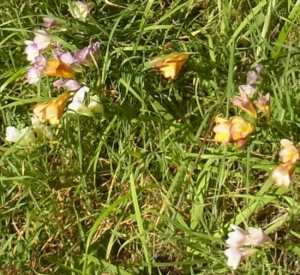
through yellow and pink, with white being the most common colour.
Freesia alba x leichtlinii is a hybrid plant derived from crossing Freesia alba and Freesia leichtlinii. This hybrid freesia was first developed by plant breeders in the late 19th century. While the parent species of F. alba and F. leichtlinii are both native to South Africa, F. alba x leichtlinii can now be found growing wild in parts of Australia as well.

The freesia hybrid is a delicate-looking plant that grows from a corm to about 16-20 inches tall. The slender stems hold attractive flowers in shdes of white, cream, yellow, pink or purple. The funnel-shaped blooms have a lovely, sweet fragrance. Plants bloom in the summer and fall.

In the wild in South Africa, both parent species of freesia grow in rocky, dry slopes and grasslands. However, in Australia F. alba x leichtlinii has naturalized and can be found along roadsides, fields and in waste areas. The climate along coastal southeastern Australia provides suitable habitat for the plants to thrive. They readily reseed prolifically.

While valued as ornamentals, freesia species have also become troublesome invasive weeds in Australia. The fast-spreading freesias compete with native vegetation and alter local ecology. Control efforts include manual removal, mowing and herbicide sprays. Care must be taken to prevent further freesia dispersal when disposing of plants.

With their graceful flowers and sweet scent, freesias are still popular ornamental plants around the world. Breeders continue to develop new flower colors and forms for the cut flower trade and gardens. The story of F. alba x leichtlinii shows how a beautiful hybrid plant can sometimes escape our control and become an invasive pest in new environments.