
Overview
Matisia cordata is native to the neotropical lowlands and has been successfully cultivated in higher altitudes up to 1,500 meters. This species has since been introduced to various tropical countries, including regions in northern Australia.
Habitat and Growth Conditions
Thriving in warm, humid tropical and subtropical rainforests, Matisia cordata prefers temperatures above 18°C and is not frost-tolerant. In its native environment, it receives an annual precipitation of about 2,500 mm, well-distributed throughout the year.
Tree Description
Depending on the climate, Matisia cordata can be an evergreen or semi-deciduous tree. It typically features a straight, grey-brown, rugged trunk with stiff branches arranged in tiered whorls, creating a pagoda-like canopy. In cultivation, the tree can grow to heights of 10-15 meters, while it can reach even greater heights in the wild. The trunk and branches exude copious amounts of yellow sap when injured.
The tree boasts large, simple, cordate leaves that are 25-40 cm long, glabrous, and green on the upper side with a paler hue below. These leaves cluster in whorls near the branch tips on long petioles, showcasing prominent palmate veins. The root system is primarily shallow, with just a few deeper roots providing stability.
Taxonomy
Matisia cordata is a member of the vast Malvaceae family, which contains over 240 genera and around 4,000 species. Previously, it was classified under the Bombaceae family. Relatives within this family include durian, saba nut, Malabar chestnut, and baobab. The genus Matisia includes more than 30 species.
Soil and Propagation
For optimal growth, Matisia cordata thrives in deep, free-draining fertile soils rich in organic matter. Although the plant is not particularly demanding regarding pH levels, slightly acidic conditions are preferred.
Propagation is primarily achieved through seeds, which are recalcitrant. To maintain seed viability, it is important to remove as much fibrous flesh as possible surrounding the seed before sowing it quickly. Epigeal phanerocotylar germination is generally successful and occurs rapidly within 2-3 weeks, especially when bottom heat is applied. The cotyledons have a unique corrugated appearance. While grafting is possible, it does not significantly reduce the juvenility period.
Currently, wild tree selections have been made, but no scientific breeding efforts have led to the development of named cultivars. Desirable traits would include consistent bearing, self-compatibility, a high flesh ratio, and minimal fiber.
Flowering
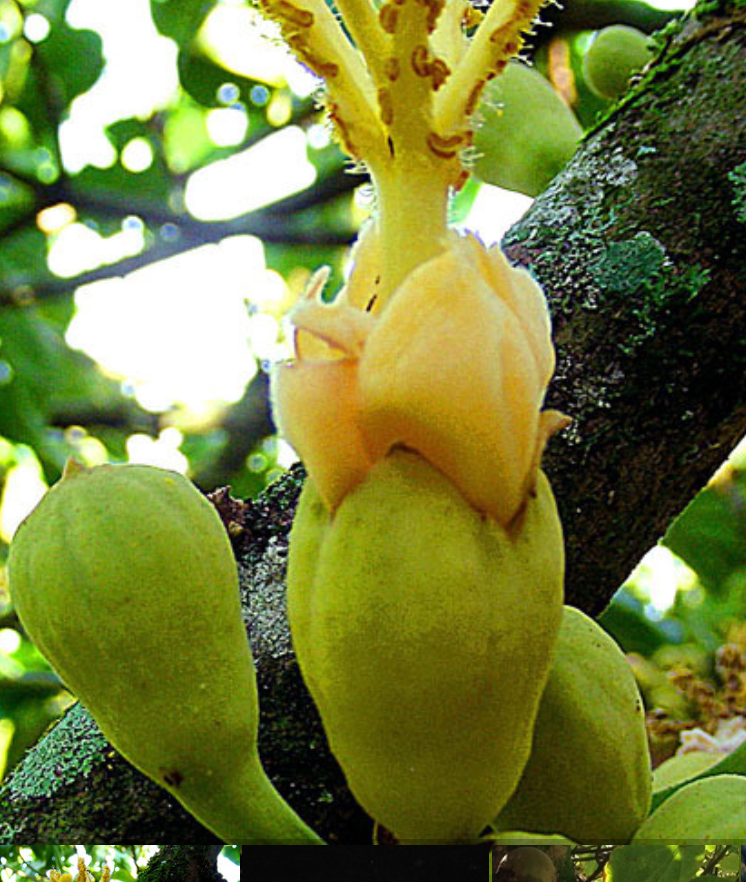
The inflorescences consist of ramiflorous fascicles that bear 1-3 orange-yellow hermaphrodite flowers, each about 2.5 cm wide. These flowers grow on older branches and can form clusters at the branch tips. The tomentose calyx is 2-5 lobed, and the corolla features obovate petals, with two petals smaller than the other three. The staminal filaments fuse into a tube with five spreading lobes, and each flower contains approximately 12 anthers. The puberulent style is shorter than the stamens, and the superior ovary has five locules.
Flowers typically open at night and become receptive the following day. Most trees are self-incompatible, with only 10-15% capable of independently setting fruit. Pollinators include bees, wasps, some birds, and, if present, bats.
Planting and Maintenance
Plants should be established in full sun after experiencing seedling hardening. While no studies have determined optimal management practices, Matisia cordata benefits from consistently moist, fertile soil with good drainage. This species exhibits allelopathic activity, which can affect surrounding plants. Additionally, trees require protection from strong winds.
Standard practices involve removing any dead wood, and it may be necessary to control the size of the tree. Skirting is generally unnecessary, as there is typically a substantial trunk before the first tier of branches.
Fruit Characteristics
The fruit of Matisia cordata is indehiscent, measuring 8-14 x 6-12 cm and weighing between 200-500 grams, although some can be much larger. These globose or ovoid drupes have a prominent rounded knob at the apex and a two to five-lobed, leathery, persistent calyx. The thick, tomentose rind is green when immature, turning brown as it ripens and dries. The attractive, soft, sweet, yellow-orange pulp has low acidity and a pleasant aroma, containing about 12% soluble solids. The fruit houses 2-5 hard seeds measuring 2.5 x 4 cm, with fibers extending into the pulp, reminiscent of mangoes. The edible pulp constitutes approximately 30-40% of the whole fruit. Notably, the strongest nutritional benefits stem from its polyphenol antioxidants and carotene content.
Growth and Harvest
Under optimal conditions, Matisia cordata grows rapidly, with a juvenility period of 5-7 years. Mature trees may experience one or more seasons of flowering before bearing fruit. In the neotropics, fruit maturation takes 6-8 months, which may be extended in different climates. The fruit is ready for harvest when the calyx lifts slightly, revealing a light-colored ring around its perimeter. It is not advisable to wait for the fruit to fall, as this indicates overripeness. A mature tree can yield between 300-1,000 fruits per annum, given suitable pollination and care. However, alternate bearing can pose a challenge. The fruit can be stored for approximately two weeks at room temperature.
While Matisia cordata fruits are typically enjoyed fresh, they can also be processed into juices or incorporated into desserts like ice cream. This fruit is particularly popular in its native regions of South America.
Challenges in Cultivation
Although relatively unknown in Australia, there have been reports of fruit fly attacks in South America. The species is currently being trialed in Australia, but its success remains uncertain due to being located below the southern boundary of its native latitudes. The hot, dry summers and non-fertile calcareous soils present significant challenges. While some seedling trees may have appealing characteristics, the fibrous flesh might not be well-received by everyone. To mitigate issues with alternate bearing, it is recommended to thin the trees during “on” years, and consider grafting or planting a second specimen to address self-incompatibility.