
Native to the highlands of northern South America. It is now grown in many sub-tropical countries but only New Zealand and a few areas of South America have commercial operations of significance.
Tamarillo is a sub-tropical species that grows in areas with rainfall of 600-4000mm pa and annual temperatures of 1525°C. It will also grow in more tropical areas with sufficient elevation, 1000-3000m. Young plants will not withstand frost; more mature plants may lose their foliage if it is light or be killed if heavier or more frequent. Climates conducive to citrus culture support tamarillo. Humid environments increase disease load.
It is a short-lived fast-growing softwood small tree, 1.5-5m high, that has a shallow root system. The fragile trunk and branches break easily if subjected to much stress. The simple alternate axillary heart-shaped leaves are evergreen or deciduous depending on climate, very large, 20-40cm long and 20-35cm wide, and have a soft hairy covering on the underside. Tamarillo forms an endo-mycorrhizal association which considerably improves nutrient supply and the ability to withstand nematode infections.
Solanaceae Family. Related to casana, tomato, Cape gooseberry, pepino, naranjilla and many more.
Best yields are obtained in deep fertile soils, but generally it is not an exacting plant provided drainage is good. Almost any waterlogging will seriously harm or kill the tree. A wide soil pH range is tolerated, 5-8.5.
Seed or cuttings are used without any particular problems. Seedling grown trees will have a taller form whereas those from cuttings will be shorter and more bushy. Vegetative propagation by cuttings has the normal advantage of preserving favoured tree characteristics, but can pass on viral infections. Seedlings come through reasonably true to type. For continuous production, renewal plants should be available because trees are productive for only about 8 years, usually succumbing to viral infections.
There are many named varieties which basically have resulted from selection rather than systematic breeding programs. The species is still relatively undeveloped as a horticultural crop.
Some cvs are Goldmine, Inca Gold, Red Delight, and Rothamer. It can be difficult to source some of these as Nursery stocks are often seedlings or cuttings from unknown plants.
Cool temperatures promote flowering. Flowers occur in groups of 3-10 in axillary cymes or racemes near the ends of branches. The fragrant, self-pollinating flowers have a pink-white corolla and 5 stamens with yellow anthers that are attractive to insects. Flowers open sequentially over a period of days within an inflorescence. Pollination is achieved by bees but wind can contribute if it is strong enough to shake the flowers. Fruit set is initially 12% but only 3% may be carried through to maturity, so that each inflorescence may ultimately bear 1-5 fruit. A few trees set fruit parthenocarpically but these are only a small fraction of normal size.
Tamarillos need full sun and a continuous supply of water, so irrigation is necessary in dry periods. NPK fertilizer should be given annually, with half each in Spring and Summer. Competition for nutrients and water by weeds should be avoided. Mulches suppress weed growth, enhance water and nutrient retention and combat nematode infections, particularly in sandy soils.
They do not withstand strong winds and may be blown over, the large leaves shredded and branches broken. Accordingly they should be planted in a protected area.
Tamarillos produce their fruit on current season’s growth. When pruning your trees, remove dead, diseased and crowded old wood. To promote strong new growth, cut back the laterals that have fruited. If trees are not pruned, the new fruiting wood gradually extends from the ends of the branches and laterals and the middle of the tree is left more or less barren. The fruit that is produced on the ends of these branches and laterals which are weak and spindly are generally poor in size, and the weight of the fruit will cause them to break. Pruning should be done every year after harvest to encourage new fruiting laterals and keep the canopy close to the trunk. Trellising is a good option for protective support. Harvest period can be delayed by pruning late.
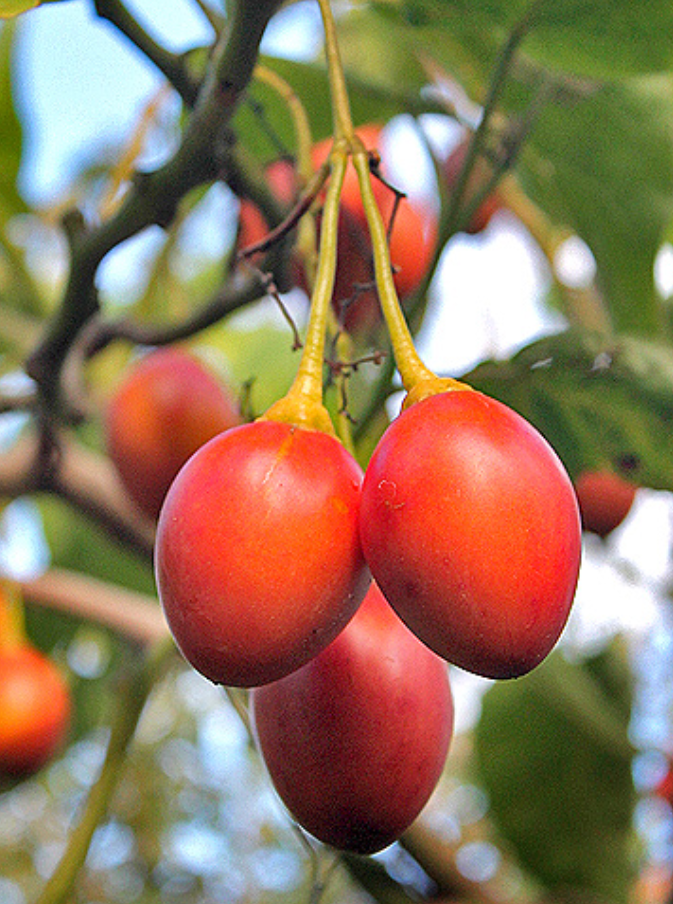
Fruit are elliptical to ovoid, 4-8cm long and 3-5cm wide, with many enclosed seeds a little larger than those of tomato. The tough inedible skin can be yellow, orange, red or purple with longitudinal darker stripes. The orange flesh has good levels of Vitamins A and C with 10-15% sugars and an acid pH.
Tamarillos are precocious and can start fruiting at 18 months; however it will be 3-4 years before mature yields are produced. In seasonal climates such as Perth, flowers form in Spring and fruit ripen in late Autumn/Winter. Maturation of fruit is staggered, requiring multiple harvests. Even though they are small trees, yields of 20-30kg can be achieved. They should be picked when fully-coloured as otherwise they are quite acid. At 4°C they will store for 2-3 months.
Only the sweeter varieties are usually eaten fresh by spooning out the pulp. Maximum sweetness is obtained when the fruit are fully ripe. If desired, the skin is easily removed with blanching. They are used in many processed forms such as sauces, chutney, flavouring yoghurt and ice cream, and are included in jams for their high level of pectins.
Not many problems, but aphids should be controlled to minimise lethal viral infections. Nematode attack is decreased with increased organic matter in soils. Diseases include powdery mlldew, root rots (Phytophthora) and anthracnose.
In areas without frosts such as Perth, tamarillos will rapidly produce a bounteous harvest without many problems. They do need protection from wind and a constant supply of water. Late Autumn fruiting which is staggered and outside the period when most other fruits mature is a benefit to the home-grower.
Solanum betaceum, commonly known as Tamarillo or Tree Tomato, is a subtropical fruit tree native to the highlands of northern South America. This fascinating species offers both ornamental value and delicious fruit, making it a prized addition to subtropical fruit enthusiasts’ collections.
Origin and Distribution
- Native to the highlands of northern South America
- Now grown in many subtropical countries
- Commercial operations of significance in New Zealand and some areas of South America
Climate and Growing Conditions
- Subtropical species
- Annual rainfall: 600-4000mm
- Annual temperatures: 15-25°C
- Can grow in tropical areas at elevations of 1000-3000m
- Young plants are frost-sensitive; mature plants may lose foliage in light frost or be killed by heavier frost
- Thrives in climates suitable for citrus culture
Plant Description
- Short-lived, fast-growing softwood small tree
- Height: 1.5-5m
- Shallow root system
- Large, heart-shaped leaves (20-40cm long, 20-35cm wide)
- Forms endo-mycorrhizal associations
Cultivation
- Soil: Prefers deep, fertile soils with good drainage
- pH tolerance: 5-8.5
- Propagation: Seeds or cuttings
- Fertilization: NPK fertilizer applied annually (half in Spring, half in Summer)
- Irrigation: Continuous water supply needed, especially in dry periods
- Protection: Needs shelter from strong winds
Fruit Characteristics
- Shape: Elliptical to ovoid
- Size: 4-8cm long, 3-5cm wide
- Skin color: Yellow, orange, red, or purple with darker stripes
- Flesh: Orange, good levels of Vitamins A and C
- Sugar content: 10-15%
Harvesting and Storage
- Production begins: As early as 18 months, full production at 3-4 years
- Harvest season: Late Autumn/Winter in seasonal climates
- Yield: 20-30kg per tree
- Storage: 2-3 months at 4°C
Culinary Uses
- Fresh consumption (sweeter varieties)
- Sauces and chutneys
- Flavoring for yogurt and ice cream
- Jams (high pectin content)
Challenges for Cultivation
- Wind damage
- Viral infections (transmitted by aphids)
- Nematode attacks in sandy soils
- Diseases: powdery mildew, root rots, anthracnose
FAQ
Q1: How long does it take for a Tamarillo tree to bear fruit?
A: Tamarillo trees are precocious and can start fruiting as early as 18 months, but it takes 3-4 years to reach mature yields.
Q2: Can Tamarillo trees be grown in containers?
A: Yes, due to their small size and shallow root system, Tamarillos can be grown in large containers, which is ideal for regions with colder winters.
Q3: Are there different varieties of Tamarillo?
A: Yes, there are several named varieties, including Goldmine, Inca Gold, Red Delight, and Rothamer. However, these are mostly selections rather than results of systematic breeding programs.
Q4: How do you eat Tamarillo fruit?
A: For fresh consumption, cut the fruit in half and scoop out the pulp with a spoon. The skin is usually not eaten. They can also be used in various processed forms.
Q5: How often should Tamarillo trees be pruned?
A: Tamarillo trees should be pruned annually after harvest to encourage new fruiting laterals and keep the canopy close to the trunk.
Q6: Can Tamarillo trees be grown in temperate climates?
A: While Tamarillos prefer subtropical climates, they can be grown in temperate areas if protected from frost. In colder regions, they’re often grown as container plants and moved indoors for winter.
Q7: How long do Tamarillo trees live?
A: Tamarillo trees are generally productive for about 8 years, often succumbing to viral infections after this period. For continuous production, it’s advisable to have renewal plants available.
This improved content provides a comprehensive overview of Solanum betaceum (Tamarillo), highlighting its unique characteristics, cultivation requirements, and potential challenges. The added FAQ section addresses common questions that potential growers or enthusiasts might have about this intriguing subtropical fruit tree.
Citations:
[1] https://www.rayon-de-serre.com/a-collaboration-with-the-botanical-garden-orchard-of-flavours-/493-solanum-betaceum.html
[2] https://plantura.garden/uk/fruits/tamarillo/tamarillo-overview
[3] https://rarefruitclub.au/wp/fruit-trees/sandoricum-koetjape-indicum/
[4] https://epicureanearth.com/all-about-the-ambarella/
[5] https://www.growables.org/information/TropicalFruit/tamarillo.htm
[6] https://en.wikipedia.org/wiki/Santol_%28fruit%29
[7] https://www.growables.org/information/TropicalFruit/Ambarella.htm
[8] https://www.epicgardening.com/june-plum-tree/